What Is a Mental Health Crisis Plan? Your Guide

TL;DR:
A mental health crisis plan is a personalized, written document created during stability, detailing triggers, warning signs, and emergency contacts to guide care when communication is impossible. It must be regularly reviewed and tailored to individual needs to ensure quick, effective intervention within the first 72 hours of a crisis. Building this plan collaboratively with healthcare providers and loved ones significantly improves safety and long-term outcomes during psychiatric emergencies.
A mental health crisis can arrive without warning. One moment, a person is managing. The next, they are overwhelmed, unsafe, or unable to communicate what they need. Over 28 million adults in the U.S. received no mental health treatment in 2025, which means that when a crisis does hit, most people have no plan in place. Understanding what is a mental health crisis plan can change that. It is a personalized, written document created during a period of stability that tells the people around you exactly how to help when you cannot speak for yourself.
Table of Contents
Key Takeaways
Point | Details |
Created during stability | A crisis plan is written when you feel well, so it reflects your clearest thinking about what helps you. |
Includes critical personal details | Triggers, warning signs, medications, and emergency contacts all belong in your plan. |
Early action saves lives | Getting support within the first 72 hours significantly reduces the risk of hospitalization. |
Plans must be updated regularly | Review your plan at least once a year or after any major life or medication change. |
No wrong door for help | Any entry point, from telehealth to a crisis line, can start the support process your plan calls for. |
What is a mental health crisis plan and what it includes
A mental health crisis plan is a written document that outlines exactly what should happen if you experience a psychiatric emergency. It is not a general wellness guide. It is a specific, personal, and practical roadmap created collaboratively with your care team, family members, or both. Think of it as your voice when you no longer have the words.
Clinical guidelines describe a strong crisis plan as including the following core elements:
Personal triggers: The specific events, environments, or interactions that tend to set off your symptoms
Early warning signs: Behavioral or emotional changes that signal a crisis may be building, such as sleep disruption, social withdrawal, or increased irritability
Current medications and allergies: An accurate, up-to-date list that emergency responders or hospital staff can reference immediately
Contact details: Your psychiatrist, therapist, and at least one trusted personal advocate who knows your history
Preferred interventions: Specific coping strategies that work for you, plus approaches you want to avoid
Emergency escalation steps: Clear instructions for when to call 988 (the Suicide and Crisis Lifeline), go to an emergency room, or contact a mobile crisis team
Plans are not one-size-fits-all. A crisis plan for a child with autism spectrum disorder looks very different from one created for an adult managing postpartum depression or an adolescent with ADHD and school refusal. The mental health triage process for children and teens involves additional considerations, including school contacts and parental roles, that adult plans typically do not.
Pro Tip: Write your plan in plain language. If a neighbor or first responder had to read it cold, they should understand every instruction within 60 seconds.
Recognizing the signs of a mental health crisis
Spotting a crisis early is one of the most protective things you can do. The challenge is that high stress or trauma events can trigger rapid deterioration, and the warning signs are often mistaken for personality changes or “bad days.”
Common signs that a mental health crisis may be developing include:
Sudden withdrawal from friends, family, or activities once enjoyed
Talking about feeling hopeless, worthless, or like a burden to others
Marked changes in sleep, eating, or hygiene without a clear physical cause
Increased agitation, anger outbursts, or paranoid thinking
Self-harm behaviors or statements about not wanting to be alive
For children and adolescents, school refusal, regression, or sudden drops in academic performance
For new mothers, intrusive thoughts, emotional numbness, or an inability to bond with the baby, which may signal a postpartum mental health crisis
The severity of a crisis exists on a spectrum. Someone experiencing heightened anxiety or a depressive episode that is worsening sits at one end. Active suicidal ideation or a break from reality sits at the other. The important thing is not to wait for the most severe presentation before acting.
Understanding a person’s medical and mental health history makes recognition much faster. If you already know that your teenager’s OCD tends to spike around exam periods, or that your partner’s depression deepens in winter, you can watch for those specific patterns rather than trying to interpret behavior from scratch.

How to create a crisis plan that actually works
The most effective crisis plans are built during calm, stable periods. Creating one in the middle of a psychiatric emergency is like writing evacuation routes while the building is on fire. The process should be thoughtful, collaborative, and unhurried.
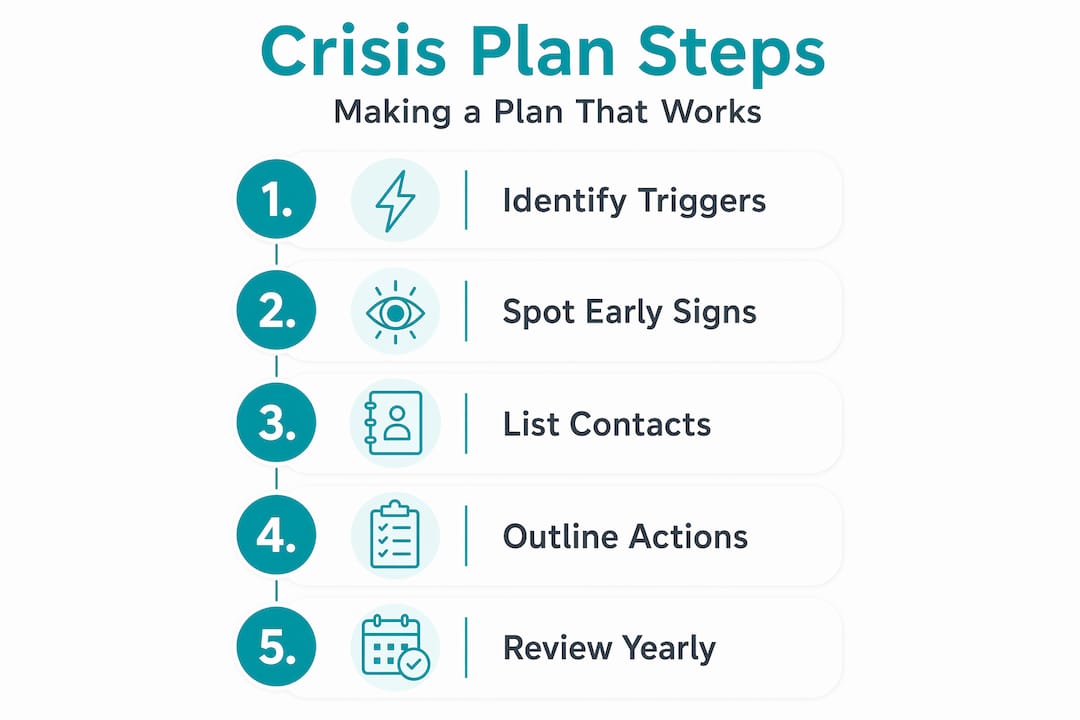
Here is a practical approach to building your mental health emergency plan:
Schedule time with your provider. Your psychiatrist or therapist is your most important partner in this process. Safety contracts and stepwise plans developed collaboratively during mental stability increase patient control and significantly improve crisis outcomes.
Identify your personal warning signs. Work backward from past crises if you have had them. What changed in the days or weeks before things got bad? Write those patterns down in specific, observable terms.
List your medications accurately. Include dosages, prescribing doctors, and any known allergies or adverse reactions. An incomplete medication list in an emergency can lead to dangerous drug interactions.
Choose and brief your emergency contacts. Do not just list names and phone numbers. Actually sit down with the people you list and walk them through the plan. A contact who has never read your plan is not much more useful than no contact at all.
Specify preferred and avoided interventions. If physical restraint worsens your anxiety, write that down. If a specific breathing exercise helps you ground yourself, include the steps. Specificity here is everything.
Create accessible copies. Keep a physical copy at home, store a digital version in your phone, and share copies with your care team. If you are working with a telehealth provider, ask them to keep a copy in your file.
Review your insurance coverage. Understanding what your plan covers for psychiatric care coordination prevents delays when a crisis occurs. A resource like this guide on verifying psychiatric insurance coverage can help you sort that out in advance.
For families supporting children or adolescents, involving a child and adolescent psychiatrist in plan creation is strongly recommended. For parents managing a child’s ADHD, anxiety, or autism spectrum disorder, crisis plans often include school-specific protocols and teacher contacts alongside clinical resources.
Pro Tip: If you receive telehealth psychiatry services in New York, ask your provider to co-author your crisis plan during a scheduled session. Having it on file with your telehealth practice means it is accessible statewide, not just in one location.
Why the first 72 hours matter most
Time is a critical variable in mental health crises. Early intervention within 72 hours drastically reduces escalation to inpatient psychiatric hospitalization and improves long-term outcomes. This is not just a clinical recommendation. It is one of the most well-supported findings in crisis care research.
A well-prepared crisis plan directly supports fast action during this window. When the people around someone in crisis already know who to call, what to say, and which interventions to try first, the critical early hours are not wasted figuring out logistics.
Support entry point | When to use it | What it provides |
988 Suicide and Crisis Lifeline | Immediate emotional distress or safety concerns | Phone, chat, and text support 24/7 |
Telehealth psychiatry | Worsening symptoms before full crisis | Same-day or next-day appointments available |
Mobile crisis teams | Active crisis at home | In-person support without police involvement |
Emergency room | Immediate safety risk | Medical and psychiatric stabilization |
Peer support specialists | Post-acute recovery support | Lived-experience guidance and practical help |
Peer support specialists with lived experience of mental illness offer something clinical providers sometimes cannot: the credibility of personal recovery. They improve emotional support and help people navigate next steps during and after a crisis with real understanding.
“There is no wrong door when it comes to accessing help. Any entry point can begin the support process. What matters is that someone reaches out.” (Source)
Early, responsive care within the first 72 hours is also more cost-effective than inpatient stays, which makes coordinated outpatient and telehealth responses not just compassionate, but practical.
Common mistakes that make crisis plans fail
The biggest mistake people make is not having a crisis plan at all. The second biggest mistake is having one that is outdated, incomplete, or unknown to anyone who matters.
Here is what to watch for and avoid:
Waiting for a crisis to start planning. A crisis plan created in the middle of an episode is reactive, emotional, and often incomplete. The importance of crisis planning is that it happens well before it is needed.
Failing to update after changes. Dynamic, updated crisis plans reviewed yearly or after major life or medication changes are far more effective than static documents. A medication list from two years ago is not just outdated. It could be dangerous.
Listing contacts who have never been briefed. Your emergency contact needs to understand their role, know where the plan is stored, and feel comfortable acting on it without hesitation.
Ignoring condition-specific needs. A child with ADHD may need a different de-escalation approach than an adult with OCD. Families supporting someone with postpartum depression or autism spectrum disorder should build those nuances into the plan explicitly.
Not connecting to outpatient or telehealth care. Crisis plans work best when they are part of an ongoing care relationship, not a standalone document. Integrating telehealth psychiatry in New York means your care team is accessible even if you cannot get to White Plains or Brooklyn in person.
Pro Tip: Set a calendar reminder once a year to review your crisis plan. Treat it like renewing a driver’s license. It should always reflect where you are right now, not where you were.
My perspective: what I’ve learned about crisis planning
I’ve worked with children, adolescents, and adults across New York, and one thing I’ve seen consistently is this: the people who fare best during a crisis are the ones who did the quiet, unglamorous work of preparing before anything went wrong.
Conventional crisis management in the mental health system is still too reactive. Someone hits rock bottom, gets stabilized, and is discharged with a follow-up appointment in three weeks. That gap is exactly where the next crisis is born. What actually protects people is a trauma-informed approach that builds stabilization skills and personalized response plans before urgency takes over.
I’ve also seen families agonize over getting crisis care “right,” especially when a child or teenager is struggling. My honest advice: start early, keep it simple, and involve your provider in every revision. A one-page document written in plain language and reviewed twice a year will outperform a perfect 10-page binder that no one actually reads.
Telehealth psychiatry has genuinely changed what is possible for people in Westchester County and across New York. Access no longer depends on geography or getting to an office. That matters in a crisis, where even a 20-minute video call with a familiar provider can interrupt an escalating episode. Start early. Share your plan widely. The goal is not to predict the future. It is to give your future self the support they deserve.
— Martin
How 2ndarc can help you build your crisis plan

At 2ndarc, we work with individuals and families across New York to build personalized, proactive psychiatric care, and that includes helping you create a mental health crisis plan that actually works when you need it most.
Our compassionate team supports children, adolescents, and adults managing anxiety, depression, ADHD, OCD, autism spectrum disorder, and postpartum mental health challenges. We offer in-person care in White Plains and Brooklyn, as well as telehealth psychiatry services available statewide, with appointments often available within 24 hours. Crisis planning is a natural part of our medication management and ongoing care coordination. Most major insurance plans are accepted, and our team can help you understand your coverage before your first appointment. If you are ready to take the first step toward proactive, personalized care, book your consultation online today.
FAQ
What is a mental health crisis plan?
A mental health crisis plan is a written, personalized document created during a period of stability that outlines triggers, warning signs, medications, emergency contacts, and preferred interventions to guide care during a psychiatric emergency.
What should be included in a crisis plan?
A crisis plan should include personal triggers, early warning signs, current medications and allergies, contact information for therapists and psychiatrists, and clear step-by-step instructions for emergency contacts and escalation.
How often should a mental health crisis plan be updated?
Crisis plans should be reviewed at least once a year or after any significant life change or medication adjustment to stay accurate and effective.
Can a crisis plan help during the first 72 hours of a mental health emergency?
Yes. Having a plan in place allows caregivers and providers to act quickly during the critical early hours, which reduces the risk of hospitalization and improves long-term recovery outcomes.
Who can help me create a mental health crisis plan?
Your psychiatrist, therapist, or a telehealth provider can help you build a personalized crisis plan. Involving trusted family members or caregivers in the process makes the plan more effective when it is actually needed.
Recommended


Comments