Teen Depression Treatment Plan Steps for Parents


TL;DR:
A teen depression treatment plan is a personalized system combining assessment, therapy, medication if needed, safety strategies, and ongoing monitoring to promote recovery. Parents play a vital role in observing symptoms, advocating for care, and coordinating the various components for effective intervention. Regular evaluation, skill-building therapy, medication adjustments, and safety planning are essential, flexible steps that adapt to a teen’s evolving needs.
A teen depression treatment plan is a structured, individualized roadmap that coordinates assessment, therapy, medication when appropriate, safety planning, and ongoing monitoring to help an adolescent recover from clinical depression. Parents who follow clear teen depression treatment plan steps give their teens a measurably better chance of recovery than those who rely on a single intervention alone. Treatment is most effective when it combines therapy, family support, school resources, lifestyle strategies, and medication when appropriate. This guide walks you through each step, drawing on clinical best practices and the adolescent psychiatry services available across New York, including telehealth options through providers like 2ndarc in White Plains and Brooklyn.
What are the teen depression treatment plan steps every parent should know?
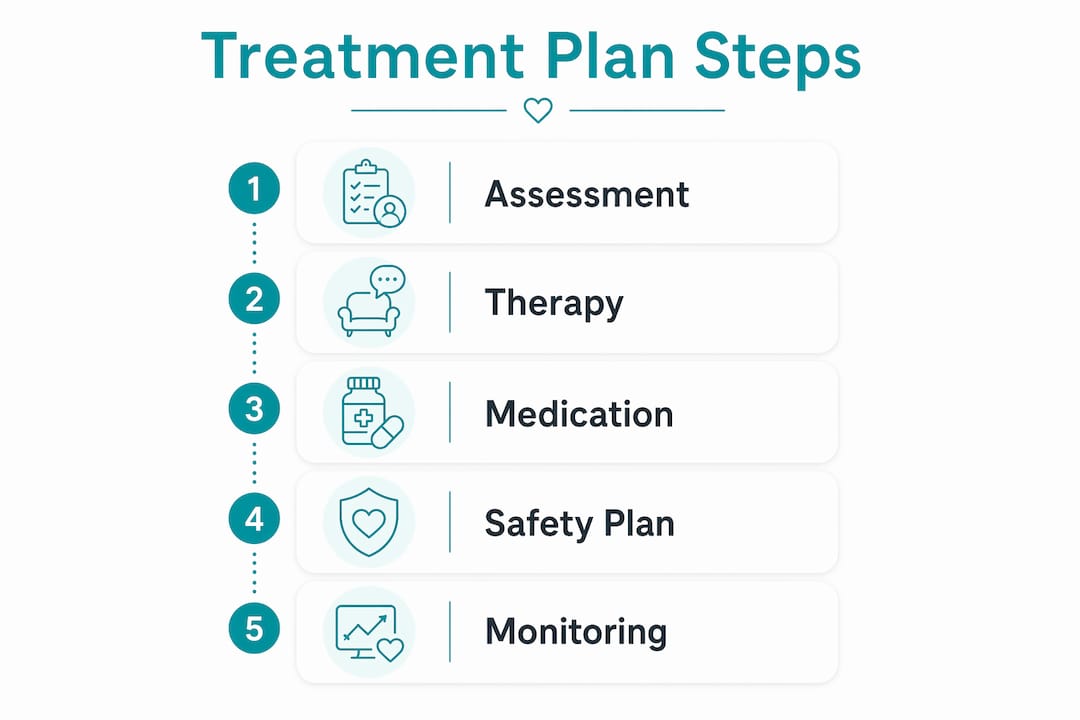
The core steps in a depression recovery plan for adolescents are assessment and diagnosis, therapy selection, medication evaluation, safety planning, and ongoing monitoring. Each step builds on the last, and skipping any one of them leaves gaps that can slow your teen’s progress. The good news is that you do not need a medical degree to participate meaningfully in every stage. Your role as a parent is to observe, advocate, coordinate, and stay present.
How do parents start the assessment and diagnosis process for teen depression?
Recognizing depression in a teenager is harder than most parents expect. Teens often present with irritability, social withdrawal, declining grades, or physical complaints like headaches rather than the classic sadness adults associate with depression. When these changes persist for two or more weeks and disrupt daily functioning, a formal evaluation is the right next step.
Start by scheduling an appointment with your teen’s pediatrician or primary care provider. These clinicians use validated screening tools to identify depression and gauge severity. The PHQ-9 and ASQ are two of the most widely used instruments. The ASQ in particular identifies 97% of youth at risk for suicide, making it a critical first filter before a specialist referral.
If the screening suggests moderate or severe depression, or if your teen has expressed any thoughts of self-harm, ask for a referral to a child and adolescent psychiatrist. A psychiatrist can conduct a comprehensive evaluation that accounts for co-occurring conditions like anxiety, ADHD, or OCD, all of which are common in depressed teens and change the treatment approach. Understanding how mental health triage works can help you prepare for this process and ask the right questions.
Before the appointment, write down specific behavioral changes you have observed, including when they started and how frequently they occur. This documentation gives the clinician a clearer picture than memory alone.
Watch for: persistent low mood, loss of interest in activities, sleep changes, appetite shifts, fatigue, difficulty concentrating, and expressions of worthlessness
Note the duration and frequency of each symptom
Ask your teen open, non-judgmental questions: “I’ve noticed you seem really tired lately. How are you feeling inside?”
Bring your notes to every appointment
Pro Tip: Ask the evaluating clinician to explain the diagnosis in plain language and request a written summary. This document becomes the foundation of your teen’s treatment plan and helps every provider stay aligned.
What therapy options are effective for teen depression?
Therapies including CBT, DBT, family therapy, trauma-focused therapy, and group therapy are each evidence-based and serve different needs within a teen’s depression treatment. Cognitive Behavioral Therapy (CBT) is the most widely studied and targets the negative thought patterns that fuel depression. Dialectical Behavior Therapy (DBT) adds skills for emotional regulation and distress tolerance, making it especially useful for teens who struggle with intense emotions or self-harm urges.

Family therapy addresses the relational dynamics that can either worsen or protect against depression. When a teen’s home environment involves conflict, poor communication, or a parent’s own untreated mental health condition, family sessions are not optional. They are a clinical priority. Trauma-focused CBT is the preferred approach when a teen’s depression is rooted in adverse childhood experiences or a specific traumatic event.
Group therapy offers something individual sessions cannot: peer connection. Depressed teens often feel profoundly alone in their experience. Hearing from peers who share similar struggles reduces shame and builds social skills simultaneously. Many adolescent psychiatry programs in New York incorporate group components alongside individual therapy.
Integrating therapy into a busy family schedule requires planning. Weekly sessions are the standard starting point, and most teens need at least 12 to 16 sessions before significant symptom reduction is visible. School accommodations, such as a 504 plan or an IEP modification, can reduce academic pressure during this period and support family involvement in the recovery process.
CBT: targets distorted thinking and builds coping skills
DBT: adds emotional regulation, mindfulness, and crisis tolerance
Family therapy: improves communication and reduces relational stressors
Trauma-focused CBT: addresses depression rooted in trauma history
Group therapy: reduces isolation and builds peer support
Pro Tip: Ask the therapist for one or two specific skills your teen is working on each month. Practicing those skills at home between sessions accelerates progress and keeps you meaningfully involved without overstepping.
When and how is medication used in teen depression treatment plans?
Medication enters the picture when depression is moderate to severe, when symptoms are disabling or include suicidal thoughts, or when therapy alone has not produced adequate improvement after several weeks. The decision is always made collaboratively between the prescribing psychiatrist, the teen, and the family.
SSRIs (selective serotonin reuptake inhibitors) are the first-line medication class for adolescent depression. Fluoxetine is often preferred because it has the strongest evidence base in pediatric populations and is FDA-approved for adolescent depression. Other SSRIs like sertraline and escitalopram are also commonly prescribed. Understanding how to combine therapy and medication is key, since medication works best when paired with active psychotherapy.
Parents frequently ask how long it takes to see results. Improvement from antidepressant pharmacotherapy may not be apparent for 1 to 4 weeks after starting treatment. That timeline is normal, not a sign that the medication is failing. Scheduled follow-up appointments during this early phase prevent premature discontinuation and help the prescriber catch side effects early.
Medication phase | What parents should do |
Weeks 1 to 2 | Track mood, sleep, appetite, and any new behaviors daily |
Weeks 2 to 4 | Report changes at the scheduled follow-up; do not adjust dose independently |
Month 2 onward | Assess functional improvement at school and home alongside symptom scores |
Discontinuation | Work with the prescriber to taper by approximately 25% per week |
If your teen’s depression improves and the prescriber recommends stopping the medication, SSRIs must be tapered gradually, decreasing the dose by roughly 25% weekly. Stopping abruptly causes discontinuation syndrome, which can include dizziness, flu-like symptoms, and mood instability. This taper must always be supervised by the prescribing clinician.
Pro Tip: Keep a simple daily log using a notes app on your phone. Record your teen’s mood on a 1 to 10 scale, sleep hours, and any notable behaviors. This data transforms your follow-up appointments from vague impressions into precise clinical conversations.
How can parents develop and use safety plans to manage crisis and suicide risk?
A safety plan is a written, personalized document that guides a teen through a mental health crisis step by step. It is not the same as a no-harm contract, which research shows is ineffective and can actually reduce therapeutic trust. The Stanley-Brown Safety Planning Intervention is the clinical gold standard. It is collaborative, practical, and reduces suicidal behavior by giving teens a concrete roadmap before a crisis escalates.
The six components of the Stanley-Brown Safety Planning Intervention are:
Warning signs the teen can recognize in themselves (specific thoughts, images, moods, or behaviors)
Internal coping strategies the teen can use alone, such as listening to music, exercising, or using a grounding technique
Social contacts and settings that provide distraction without discussing the crisis
Trusted adults the teen can reach out to for support, including family members
Professional and crisis resources, including the 988 Suicide and Crisis Lifeline and local emergency services
Means restriction, which involves removing or securing access to lethal means in the home, particularly medications and firearms
“A structured safety plan operationalizes crisis management, making it easier for teens and families to navigate acute distress.” — ICANotes, 2025
Review the plan with your teen’s therapist and practice using it before a crisis occurs. A safety plan that has never been rehearsed is far less effective than one your teen can recall under pressure. Update the plan every few months or after any significant change in your teen’s life. For a deeper look at how these plans work, the guide on mental health crisis plans covers the structure in practical detail.
What steps should parents take to monitor progress and adjust the plan over time?
Monitoring is not passive. It requires scheduled check-ins, systematic symptom tracking, and regular communication with every provider involved in your teen’s care. Treatment plans must be flexible and regularly updated because adolescent depression is rarely a straight line. Symptoms shift, stressors change, and what works at month two may need adjustment by month six.
Connect with your teen’s school counselor early in the treatment process. Teachers and counselors observe your teen for six or more hours each day and can flag changes in attention, peer relationships, or academic performance that you might not see at home. A 504 plan can formalize accommodations like extended deadlines, reduced workload, or a quiet space for breaks during high-stress periods.
Lifestyle factors carry more clinical weight than most parents realize. Consistent sleep schedules, regular physical activity, and a diet that limits processed sugar all support the neurobiological changes that therapy and medication are working to produce. These are not optional extras. They are active components of the treatment plan.
Schedule follow-ups every 2 to 4 weeks during the first 3 months of medication
Use a mood tracking app or journal to identify patterns over time
Communicate with school staff at least once per grading period
Revisit the therapy modality if your teen plateaus after 3 to 4 months
Know the threshold for escalating care: any expression of suicidal intent, a plan, or access to means requires immediate evaluation
Pro Tip: Ask each provider, the psychiatrist, the therapist, and the school counselor, to copy you on any written summaries or progress notes. Coordinated care works best when everyone is reading from the same page.
Key takeaways
A teen depression treatment plan works best when assessment, therapy, medication, safety planning, and monitoring are coordinated as a unified system rather than treated as separate, optional steps.
Point | Details |
Start with formal screening | Use PHQ-9 and ASQ tools through a pediatrician before seeking a specialist referral. |
Match therapy to your teen’s needs | CBT, DBT, family therapy, and group therapy each target different aspects of teen depression. |
Set realistic medication timelines | Improvement from SSRIs may take 1 to 4 weeks; early follow-ups prevent premature stops. |
Build and rehearse a safety plan | The Stanley-Brown model’s six components give teens a concrete crisis roadmap to practice before they need it. |
Monitor and adjust continuously | Track symptoms, coordinate with school staff, and update the plan as your teen’s needs evolve. |
What I’ve learned from watching families navigate teen depression
Working alongside families in Westchester County and across New York, the pattern I see most often is this: parents arrive with the right instincts but the wrong timeline. They expect a treatment plan to produce visible results within weeks, and when it does not, they question whether anything is working. That doubt is understandable. It is also the most common reason teens lose momentum in their recovery.
The families who see the best outcomes are not the ones with the most resources. They are the ones who stay curious instead of reactive. They ask their teen’s therapist what to look for rather than what to fix. They treat a bad week as data, not a verdict. They celebrate a teen who made it to school on a hard day with the same energy they would bring to a straight-A report card.
Telehealth psychiatry in New York has genuinely changed what is possible for families in this position. A parent in White Plains can coordinate a medication check-in during a lunch break. A teen in Brooklyn can attend a therapy session from their bedroom on a day when leaving the house feels impossible. Accessibility removes one more barrier at a moment when barriers cost real progress.
The hardest thing I tell parents is also the most honest: recovery from teen depression is not linear, and the plan is a living document, not a finished product. The families who hold that truth lightly, who stay flexible without losing their footing, are the ones who get their kid to the other side.
— Martin
Supporting your teen with expert psychiatric care in New York
If you are ready to take the next step, 2ndarc provides personalized child and adolescent psychiatry services across New York, with in-person care in White Plains and Brooklyn and telehealth options available statewide.

The 2ndarc team specializes in building individualized treatment plans for teens experiencing depression, anxiety, ADHD, OCD, and related conditions. Services include comprehensive psychiatric evaluation, medication management, therapy coordination, and crisis support. Most major insurance plans are accepted, and appointments are often available within 24 hours. Book your consultation online and take the first step toward a plan that is built around your teen, not a template.
FAQ
What is included in a teen depression treatment plan?
A teen depression treatment plan typically includes a formal diagnosis, evidence-based therapy such as CBT or DBT, medication evaluation when appropriate, a written safety plan, and a schedule for ongoing monitoring and adjustment.
How long does it take for antidepressants to work in teenagers?
Improvement from antidepressant pharmacotherapy may not be apparent for 1 to 4 weeks after starting treatment, so parents should schedule early follow-ups rather than stopping medication prematurely.
What is the Stanley-Brown Safety Planning Intervention?
The Stanley-Brown Safety Planning Intervention is a six-component, collaborative safety plan that helps teens identify warning signs, coping strategies, support contacts, and crisis resources before a mental health emergency occurs.
Can telehealth psychiatry work for teen depression treatment in New York?
Telehealth psychiatry is effective for teen depression treatment and is widely available across New York, allowing teens to attend therapy and medication management appointments from home when in-person visits are not possible.
When should a parent seek emergency help for a depressed teen?
Seek emergency help immediately if your teen expresses suicidal intent, describes a specific plan, or has access to lethal means. Call 988 for crisis support or 911 if there is immediate danger.
Recommended


Comments