How to Set Mental Health Treatment Goals: Steps That Work


TL;DR:
Effective mental health treatment relies on collaboratively setting SMART, measurable goals that guide progress and are regularly reviewed. Tracking symptom changes through standardized tools and patient self-reports helps clinicians assess improvements and adjust interventions accordingly. Consistent goal reviews, ideally every four to eight weeks, foster personalized care and long-term outcomes, especially with telehealth accessibility.
Mental health treatment goals are defined as specific, measurable outcomes that guide the direction and progress of psychiatric or therapeutic care. Whether you are managing anxiety, depression, ADHD, or navigating a new diagnosis, knowing how to set mental health treatment goals steps gives your treatment a clear structure and purpose. The Joint Commission emphasizes that measurable treatment goals are foundational to documenting clinical progress and guiding decisions over time. Without them, therapy can feel directionless. With them, every session has a purpose, and every small win becomes visible.
How to set mental health treatment goals steps: what to do first
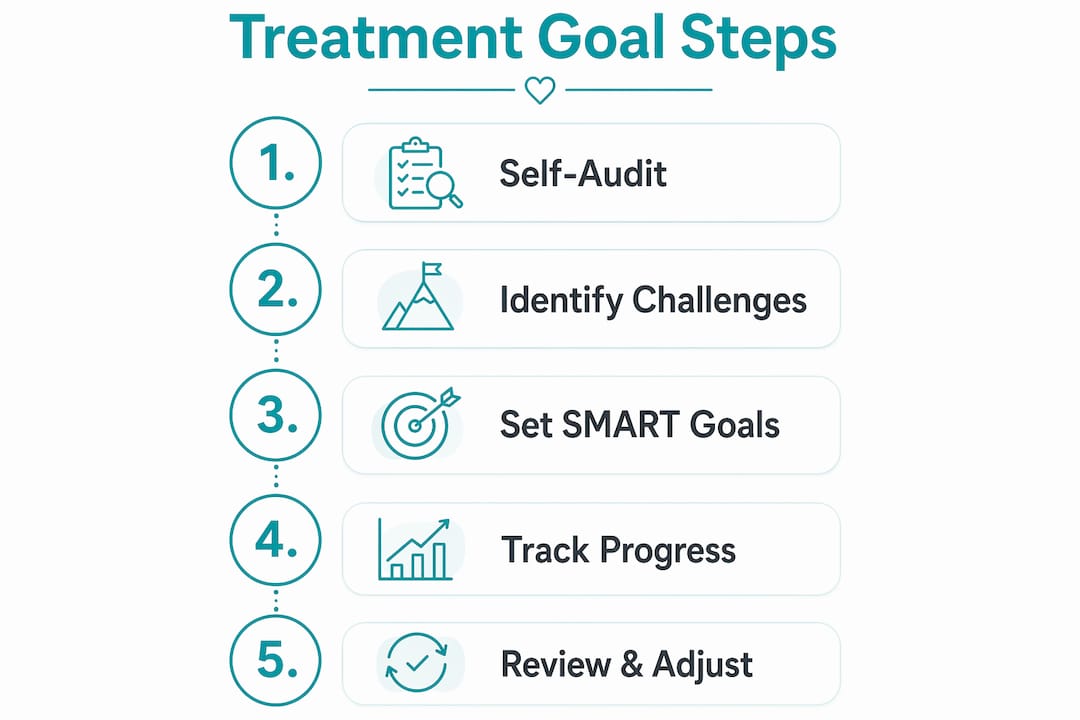
Before you write a single goal, you need a clear picture of where you are right now. This starting point is called a self-audit, and it is the foundation of effective mental health treatment planning.

Start by identifying what feels most stuck or most painful in your daily life. Are you avoiding social situations because of anxiety? Is ADHD making it hard to hold a job or finish school assignments? Is depression pulling you away from relationships or routines? Naming the specific problem is the first act of goal setting. It shifts you from “I feel bad” to “here is what is actually happening.”
Understanding your diagnosis matters just as much. A goal for managing generalized anxiety disorder looks different from a goal for managing ADHD or postpartum depression. Your psychiatrist or therapist will help you connect your diagnosis to realistic treatment targets. Spring Health advises a collaborative five-step process that begins with a client self-audit and builds toward shared goal ownership between patient and clinician.
Before your first goal-setting session, gather any relevant documentation:
Symptom logs or mood tracking records from apps like Daylio or Bearable
Previous therapy notes or medication history
Completed symptom questionnaires such as the PHQ-9 for depression or GAD-7 for anxiety
A short written list of your top two or three concerns
Pro Tip: Bring a written list of your three biggest daily challenges to your first goal-setting session. Clinicians consistently report that patients who arrive prepared move through the goal-setting process faster and with more clarity.
Setting expectations matters too. Goal setting is not a one-session task. Most patients refine their goals across two or three appointments as the therapeutic relationship deepens and the clinical picture becomes clearer.
What does a SMART mental health goal actually look like?
SMART goals replace vague intentions with concrete behavioral targets, and they are the clinical standard for structuring therapy objectives. SMART stands for Specific, Measurable, Achievable, Relevant, and Time-bound. This framework turns “I want to feel better” into a goal your care team can actually track and evaluate.
Here is how to build a SMART goal step by step:
Define the long-term goal. This is the broad functional outcome you want to reach. Example: “Reduce anxiety symptoms enough to attend work meetings without panic.”
Break it into two to four short-term objectives. Each objective is a measurable step toward the long-term goal. Example: “Practice one diaphragmatic breathing exercise daily for four weeks.”
Attach a measurement. Use standardized tools where possible. The GAD-7 score, PHQ-9 score, or a simple 0 to 10 daily distress rating all work. A structured treatment plan includes diagnosis, risk factors, goals, objectives, interventions, and target review dates.
Confirm achievability with your clinician. A goal that requires eliminating all anxiety in two weeks is not achievable. A goal that targets a three-point reduction on the GAD-7 over eight weeks is.
Set a target date. Without a deadline, goals drift. Most short-term objectives carry a four to eight week target window.
Link the goal to an intervention. Every goal needs a corresponding treatment action, whether that is cognitive behavioral therapy sessions, medication management, or a specific coping skill practice.
Here is a quick comparison of vague versus SMART goals across common conditions:
Condition | Vague goal | SMART goal |
Anxiety | “Feel less anxious” | “Reduce GAD-7 score from 14 to 9 within 8 weeks using CBT and daily breathing practice” |
Depression | “Be happier” | “Increase PHQ-9 score improvement by 5 points in 6 weeks through therapy and medication review” |
ADHD | “Focus better at work” | “Complete three work tasks per day using a timer system for 4 weeks, tracked by weekly self-report” |
Pro Tip: Write your goals in your own words first, then refine them with your clinician. Goals you helped create feel more personal and are easier to stay committed to over time.
How is progress tracked in mental health treatment?
Progress in mental health treatment is measured through a combination of standardized symptom scales, patient self-reports, and clinician observations reviewed at regular intervals. Tracking is not optional. It is the mechanism that tells you and your care team whether the plan is working or needs to change.
Validated scales like the PHQ-9 and ASQ track symptom changes objectively and guide ongoing treatment adjustments. A drop of five or more points on the PHQ-9, for example, signals a clinically meaningful improvement in depression symptoms. That number gives both patient and clinician a shared, objective reference point rather than relying on subjective impressions alone.
Practical tracking methods used in clinical settings include:
Standardized scales: PHQ-9 for depression, GAD-7 for anxiety, Vanderbilt scales for ADHD in children and adolescents
Mood and symptom journals: Daily entries noting mood, sleep, energy, and specific triggers
Session check-ins: Brief structured reviews at the start of each appointment comparing current status to baseline
Clinician notes: Documented observations that capture behavioral and functional changes over time
Progress documentation also matters for insurance purposes. Most accepted insurance plans require evidence of clinical necessity, and measurable goal progress is a core part of that documentation. Keeping records protects your access to continued care.
Clinicians use symptom score changes as decision points to revise treatment intensity, modality, or goals rather than repeating ineffective plans. This is what separates reactive care from truly personalized psychiatric treatment.
When and how should you review and adjust your goals?
Goal review is a scheduled, collaborative process, not something that happens only when treatment feels like it is failing. Most behavioral health treatment plans build in a formal review every four to eight weeks, though your clinician may adjust this based on your specific needs and the complexity of your condition.
Signs that your goals may need adjustment include:
Symptom scores that have not changed after two consecutive review periods
New life stressors or diagnoses that shift your treatment priorities
Goals that feel too easy, suggesting you are ready for more challenging objectives
Goals that feel overwhelming, suggesting they need to be broken into smaller steps
Changes in medication that affect your functional capacity or symptom profile
Treatment plans must specify review dates and explicit progress criteria. Without these, goal reviews lack the structure needed to produce real clinical decisions. When you sit down for a review session, come prepared with your tracking data and a clear sense of what has shifted since the last meeting.
Telehealth psychiatry in New York makes this process significantly more accessible. Patients in Westchester County, White Plains, and across the state can attend review sessions without rearranging their schedules around travel. Telehealth services allow patients to maintain consistent goal review and treatment adjustments remotely, improving both access and continuity of care.
Pro Tip: Schedule your next goal review appointment before you leave your current session. Patients who pre-schedule reviews are far more likely to follow through than those who plan to call later.
Common pitfalls in mental health goal setting and how to avoid them
Many clinical setbacks in mental health treatment trace back to vague outcome statements that cannot be measured or acted upon. “I want to feel more like myself” is a starting point for a conversation, not a clinical goal. Observable behavioral and symptom targets tied to specific interventions are what drive real progress.
The most common pitfalls include:
Setting too many goals at once. Focus on one to three goals per treatment cycle. Goal overwhelm leads to disengagement, not progress.
Skipping the link between goal and intervention. Every goal needs a corresponding action. A goal to reduce social anxiety requires a specific intervention, such as exposure therapy, group therapy, or a graduated social challenge plan.
Avoiding the conversation about medication. For conditions like ADHD, depression, and OCD, medication management is often a direct contributor to goal achievement. Separating medication from goal setting creates a fragmented plan.
Treating goals as fixed. Goals are living documents. Updating them is a sign of progress, not failure.
“Collaboratively defining progress helps patients recognize small wins and sustain motivation in therapy.” — Spring Health
Technology can support adherence between sessions. Apps like Woebot, Finch, or a simple notes app used consistently can capture daily data that makes your next review session far more productive. For parents managing a child’s treatment for ADHD, school refusal, or autism spectrum disorder, keeping a shared log with your child’s clinician creates accountability on both sides. You can find practical guidance on ADHD goal setting for kids that applies directly to building measurable objectives in pediatric care.
Key takeaways
Effective mental health treatment requires SMART goals built collaboratively with your clinician, tracked with standardized tools, and reviewed on a scheduled basis to ensure measurable, sustained progress.
Point | Details |
Start with a self-audit | Identify your top two or three daily challenges before your first goal-setting session. |
Use SMART criteria | Every goal must be specific, measurable, achievable, relevant, and time-bound to guide real progress. |
Track with validated tools | PHQ-9, GAD-7, and daily mood logs provide objective data that drives clinical decisions. |
Schedule regular reviews | Review goals every four to eight weeks and adjust based on symptom scores and life changes. |
Limit active goals | Focus on one to three goals per treatment cycle to prevent overwhelm and maintain momentum. |
Why collaborative goal setting changes everything
After years of observing psychiatric care across age groups and settings, the single biggest predictor of treatment success I have seen is not the diagnosis or even the medication. It is whether the patient genuinely owns their goals.
When a teenager in White Plains sits down with their psychiatrist and says, “I want to be able to go back to school without a panic attack,” that is the beginning of a real treatment plan. When a parent describes their child’s ADHD not as a behavior problem but as a barrier to friendships, that reframe opens up goals that actually matter to the family. The most effective therapy goals are shaped collaboratively, turning intentions into measurable treatment targets that both patient and clinician are invested in reaching.
Telehealth has made this collaboration more consistent than I ever expected. Patients who might have skipped a review session due to a busy week in Westchester County now join from their kitchen table. That consistency compounds. Small, regular check-ins on goal progress do more for long-term outcomes than infrequent, intensive sessions ever could.
My honest advice: do not wait until you feel ready to set goals. Set them early, set them imperfectly, and let the process refine them. The goal is not a perfect document. It is a shared commitment between you and your care team to keep moving forward.
— Martin
Start your treatment plan with 2ndarc’s psychiatric team

2ndarc provides personalized psychiatric care for children, adolescents, and adults across New York, with in-person appointments in White Plains and Brooklyn and telehealth services available statewide. The team specializes in ADHD, anxiety, depression, OCD, and medication management, building individualized treatment plans that include measurable goals from your very first session. Most major insurance plans are accepted, and appointments are often available within 24 hours. If you are ready to establish mental health goals with a compassionate, collaborative care team, book your consultation online today.
FAQ
What are mental health treatment goals?
Mental health treatment goals are specific, measurable outcomes that guide the direction of psychiatric or therapeutic care. They are developed collaboratively between patient and clinician and updated regularly based on progress.
How do SMART goals apply to therapy?
SMART goals in therapy are specific, measurable, achievable, relevant, and time-bound targets that replace vague intentions with concrete behavioral objectives. They improve clarity and accountability for both patient and clinician.
How often should therapy goals be reviewed?
Most behavioral health treatment plans include a formal goal review every four to eight weeks. Reviews use standardized symptom scores and patient feedback to determine whether goals need to be adjusted or advanced.
Can I set mental health goals if I am new to treatment?
Yes. Goal setting begins at the first or second session, often starting with a self-audit of your top challenges. Your clinician will help refine your initial ideas into measurable, realistic objectives suited to your diagnosis and stage of care.
How does telehealth affect mental health goal tracking?
Telehealth psychiatry in New York allows patients to attend goal review sessions consistently without travel barriers, improving adherence to scheduled check-ins and supporting more timely treatment adjustments.
Recommended


Comments