Why Depression and Anxiety Co-Occur: What You Need to Know

TL;DR:
Depression and anxiety frequently co-occur due to shared biological, genetic, and environmental factors, with about 77% of those with anxiety experiencing depression. Addressing sleep quality, stress levels, and social support is essential for effective treatment, which often involves combined therapy and medication tailored to both conditions. Personalized, comprehensive care that considers cultural and environmental contexts leads to better outcomes and long-term recovery.
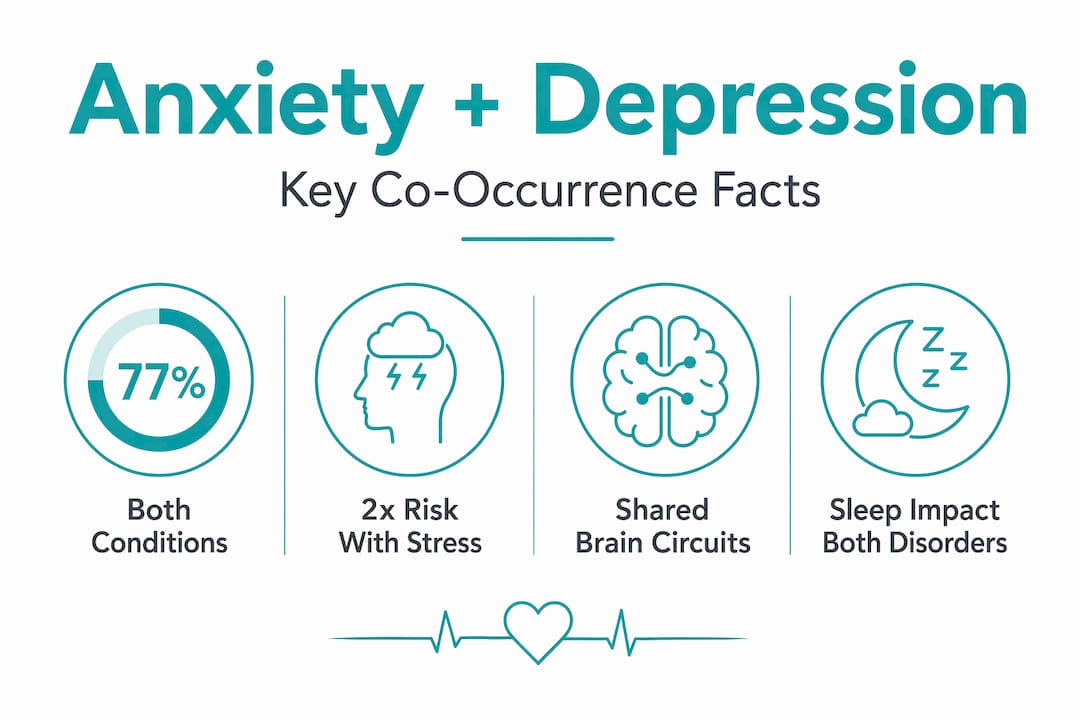
If you’ve been feeling both persistently low and constantly on edge, you’re not imagining things. Understanding why depression and anxiety co-occur is one of the most important steps you can take toward getting the right help. Many people assume they have one condition or the other, when in reality, roughly 77% of people with an anxiety disorder also report depression. That overlap isn’t a coincidence. It reflects shared biology, shared stressors, and a deeply interconnected relationship between these two conditions that science is only now fully mapping.
Table of Contents
Key takeaways
Point | Details |
High co-occurrence rate | About 77% of people with anxiety also experience depression, making dual diagnosis very common. |
Shared biological roots | Overlapping neurological and genetic vulnerabilities explain why both conditions often appear together. |
Stress multiplies risk | Chronic stress raises the likelihood of co-occurring symptoms nearly ninefold, making it a critical target for treatment. |
Symptom-focused care works better | Tracking specific symptom domains over time leads to more effective treatment than relying on a single diagnosis label. |
Modifiable factors matter | Sleep quality, stress levels, and social connections are all factors you can address to improve outcomes. |
Depression and anxiety: distinct but deeply connected
Before exploring why these two conditions so often appear together, it helps to understand what makes them different. Major depressive disorder is characterized by persistent low mood, loss of interest in activities you once enjoyed, fatigue, feelings of worthlessness, and changes in sleep or appetite. Generalized anxiety disorder, on the other hand, centers on excessive, difficult-to-control worry, physical tension, restlessness, and a constant sense of dread about future events.
Despite those differences, the two conditions share several features that make them easy to confuse and hard to separate:
Disrupted sleep. Both depression and anxiety interfere with sleep, though in different ways. Anxiety often makes it hard to fall asleep due to racing thoughts. Depression can cause either insomnia or excessive sleeping.
Irritability. Many people experiencing both conditions describe a short fuse or a low tolerance for frustration that doesn’t feel like sadness or worry at all.
Concentration problems. Difficulty focusing is a hallmark of both disorders, which can affect work, school, and relationships.
Negative thinking patterns. Both conditions fuel unhelpful thought cycles. Anxiety tends toward “what if” catastrophizing, while depression leans toward “nothing will ever change” hopelessness.
Physical symptoms. Headaches, muscle tension, stomach discomfort, and fatigue appear in both conditions, often leading people to seek medical care before mental health support.
These overlapping features mean that dual diagnosis is not only common but often clinically appropriate. Receiving two diagnoses does not mean something is more wrong with you. It means your care team has a clearer picture of what you’re dealing with.
Why depression and anxiety co-occur: shared roots
The relationship between depression and anxiety goes deeper than symptom overlap. There are biological, psychological, and environmental reasons why do anxiety and depression happen together so frequently.
Shared neurobiology and genetics
Both conditions involve dysregulation in overlapping brain systems, particularly those governing the stress response, emotional regulation, and reward processing. Serotonin, norepinephrine, and cortisol pathways are all implicated in both disorders. Genetic studies suggest that a significant portion of the heritable risk for depression and anxiety comes from the same genes, meaning someone born with a vulnerability to one condition is biologically predisposed to the other.
Chronic stress as a catalyst
Stress is one of the most powerful factors linking anxiety and depression. Research shows that stress raises co-occurrence risk nearly ninefold. When the body’s stress response stays activated over time, it wears down the systems that regulate both mood and fear. The result is a brain that is simultaneously depleted and hypervigilant, which is exactly the combination that produces anxious depression.

Sleep disruption as a shared driver
Sleep problems are not just a symptom of these conditions. They actively worsen both. Sleep disturbances independently predict co-occurring depression and anxiety symptoms, creating a cycle where poor sleep amplifies emotional dysregulation, which then makes sleep harder to achieve.
Environmental and social factors
The causes of co-occurring anxiety are not purely internal. Research using an ecological model shows that the environment plays a significant role:
Neighborhood violence increases the risk of developing both conditions simultaneously.
Parent-child closeness acts as a buffer. Mother-child closeness reduced depression odds by 18% and anxious depression odds by 31%.
School connectedness provides protective effects, particularly for adolescents, with benefits varying by gender and ethnicity.
Trauma and adverse life events prime the nervous system for both fear and despair, making comorbidity more likely after significant loss or instability.
Pro Tip: If you’re experiencing both depression and anxiety, pay attention to your sleep and stress levels first. Addressing these two factors can create meaningful relief even before other treatments take full effect, because they are independent risk drivers, not just side effects.
How clinicians assess co-occurring conditions
One reason mental health comorbidity is sometimes missed is that standard clinical tools were originally designed to assess one condition at a time. Today, most psychiatrists use validated scales to measure both depression and anxiety separately, which gives a much more complete picture.
The two most widely used tools are the PHQ-9 for depression and the GAD-7 for anxiety. Both use a scoring system that helps clinicians understand not just whether symptoms are present but how severe they are. Tracking scores over time reveals whether treatment is working and where adjustments are needed.
Scale | Condition assessed | Score range | Moderate severity threshold |
PHQ-9 | Depression | 0 to 27 | |
GAD-7 | Anxiety | 0 to 21 | 10 to 14 |
Using both scales together allows clinicians to see where the burden is greatest. Someone might score in the mild range for depression but moderate for anxiety, which changes the treatment priority. Symptom domain tracking over time, rather than relying on a single categorical label, is increasingly recognized as the standard for understanding how anxiety worsens depression and how both conditions shift across treatment.
This approach also supports what precision psychiatry calls longitudinal symptom assessment, which means looking at how your symptoms evolve rather than just taking a snapshot at one moment in time.
Practical coping strategies and treatment for both conditions
Living with co-occurring depression and anxiety calls for an integrated approach. Treating only one condition while ignoring the other rarely produces lasting improvement. Here is a practical framework for managing both:
Prioritize sleep as a treatment target. Because sleep problems predict co-occurring symptoms independently, improving sleep hygiene is not optional. Consistent sleep and wake times, limiting screen exposure before bed, and addressing any underlying sleep disorders can produce measurable mood and anxiety improvements.
Engage in therapy that addresses both conditions. Cognitive behavioral therapy has strong evidence for both depression and anxiety. When delivered by a therapist familiar with comorbidity, it can address the negative thought patterns that fuel both conditions simultaneously.
Consider medication management with a specialist. Some medications, particularly certain antidepressants, are effective for both depression and anxiety. A psychiatrist familiar with personalized treatment approaches can match medication choices to your specific symptom profile rather than applying a one-size-fits-all protocol.
Build and protect your social support network. Close relationships buffer against both conditions. Even one trusted person, whether a family member, friend, or peer support group, can reduce the severity of symptoms over time.
Reduce modifiable stressors where possible. This does not mean eliminating all stress, which is impossible. It means identifying which stressors are within your control and creating boundaries around them.
Use telehealth when access is a barrier. For many people in New York, telehealth psychiatry has removed the geographic and scheduling barriers that once kept them from getting consistent care. Whether you’re in Westchester County, Brooklyn, or a more rural part of the state, quality psychiatric support is now more accessible than ever.
Pro Tip: When seeking treatment for both depression and anxiety, ask your provider directly: “Are you treating both conditions together, or just one?” A provider who addresses the full picture, including sleep and stress, will typically produce better outcomes than one focused narrowly on mood alone.
Anxious depression is consistently more severe than depression without anxiety, with higher rates of suicidal ideation and poorer day-to-day functioning. This is not meant to alarm you. It is meant to underscore why getting the right, specialized care matters so much.
Demographics, culture, and comorbidity risk
The factors linking anxiety and depression do not affect everyone equally. Understanding these differences helps explain why some people are at higher risk and why culturally responsive care is so important.
Research shows that comorbidity rates are higher among females and certain racial and ethnic groups. This reflects a combination of biological differences, greater exposure to adverse social conditions, and the compounding effect of systemic stressors like discrimination and economic instability.
Cultural context also shapes how people understand and talk about their symptoms:
Some cultures express emotional distress primarily through physical symptoms, which can delay a mental health diagnosis.
Stigma around mental illness varies significantly across communities and can discourage people from seeking help even when symptoms are severe.
Language barriers can make it harder to accurately describe symptoms to a provider, leading to incomplete assessments.
For New York’s diverse population, this means that culturally informed psychiatric care is not a bonus feature. It is a clinical necessity. Telehealth psychiatry services that accommodate different languages, schedules, and cultural frameworks are especially valuable for reaching people who might otherwise go without support.
My perspective on treating anxious depression
I’ve worked with many patients who came in convinced they had “just anxiety” or “just depression,” only to discover that both were present and feeding each other in ways they hadn’t recognized. What I’ve found is that the patients who make the most meaningful progress are not necessarily the ones who respond fastest to medication. They are the ones whose care plan directly addresses sleep and stress alongside mood.
In my experience, two patients can walk in with nearly identical PHQ-9 scores and respond to completely different treatments. One person’s depression is being maintained by anxiety-driven insomnia. Another’s is rooted in a loss of purpose and social connection. Standard protocols don’t always catch that distinction. What does catch it is a thorough, curious conversation about the full picture of someone’s life.
I’ve also seen how much environment matters. A teenager in a high-conflict home, a new parent in Westchester County managing postpartum anxiety, an adult in Brooklyn navigating a high-pressure job with no social support. These are not background details. They are central to why the symptoms exist and what it will take to address them.
My honest take: if you’ve been struggling with both low mood and persistent worry, don’t wait for one to resolve before addressing the other. Seek out a provider who treats both together, who asks about your sleep, your stress, and your relationships, and who adjusts the plan when something isn’t working. That kind of personalized, attentive care is what actually moves the needle.
— Martin
Personalized psychiatric care at 2ndarc
If what you’ve read here resonates with your own experience, you don’t have to keep navigating it alone.

At 2ndarc, our team provides personalized psychiatric care for children, adolescents, and adults across New York, including in-person visits in White Plains and Brooklyn, as well as telehealth psychiatry services available statewide. We specialize in treating co-occurring conditions like depression and anxiety, along with ADHD, OCD, autism spectrum disorder, and postpartum mental health. Our providers take the time to understand your full symptom picture and build a treatment plan around your specific needs. Most major insurance plans are accepted, and appointments are often available within 24 hours. Take the next step and book your consultation at 2ndarc today.
FAQ
Why do depression and anxiety occur together so often?
Depression and anxiety share overlapping neurological pathways, genetic vulnerabilities, and common risk factors like chronic stress and poor sleep. Research shows about 77% of people with anxiety also experience depression, reflecting how deeply connected these conditions are at a biological and environmental level.
What are the symptoms of having both depression and anxiety?
Common overlapping symptoms include disrupted sleep, irritability, difficulty concentrating, physical tension, and persistent negative thinking. Depression typically adds low mood and loss of interest, while anxiety adds excessive worry and a sense of dread about the future.
How does stress contribute to co-occurring anxiety and depression?
Chronic stress is one of the strongest risk factors for mental health comorbidity. Studies show that stress raises co-occurrence risk nearly ninefold by depleting the brain systems that regulate both mood and fear responses simultaneously.
What does treatment look like for both conditions at once?
Effective treatment typically combines therapy (especially cognitive behavioral therapy), medication management tailored to your symptom profile, and targeted attention to sleep and stress. A psychiatrist who tracks both PHQ-9 and GAD-7 scores over time can adjust your plan as your symptoms evolve.
Is it possible to fully recover from co-occurring depression and anxiety?
Yes. Many people experience significant and lasting improvement with the right, personalized care. Addressing modifiable factors like sleep, stress, and social support, alongside professional treatment, gives you the best chance of long-term recovery.
Recommended


Comments