How Psychiatry Treats Anxiety Disorders Effectively

Anxiety disorders are the most common mental health conditions in the United States, yet most people who seek help carry one damaging assumption into their first appointment: that a prescription will fix things. Understanding how psychiatry treats anxiety disorders requires letting go of that idea. Psychiatric treatment is not a single pill or a single conversation. It is a structured, evidence-based process that combines accurate diagnosis, targeted psychotherapy, medication when appropriate, and concrete lifestyle guidance. This article walks you through exactly what that process looks like and what you can realistically expect.
Table of Contents
Key Takeaways
Point | Details |
Diagnosis comes first | Psychiatrists conduct thorough clinical interviews and use standardized scales before recommending any treatment. |
CBT is the gold standard | Cognitive behavioral therapy over 12 to 20 sessions produces the strongest evidence for lasting symptom reduction. |
SSRIs lead medication options | First-line medications improve symptoms in 30 to 50% of patients, but response takes weeks and titration matters. |
Combination therapy wins | For moderate to severe anxiety, combining medication with psychotherapy outperforms either approach alone. |
Lifestyle changes support recovery | Sleep, exercise, and mindfulness are not optional extras. They actively improve psychiatric treatment outcomes. |
How psychiatry treats anxiety disorders: the diagnostic foundation
Before any treatment begins, a psychiatrist has to understand exactly what they are treating. Anxiety is not a single condition. It is a category that includes generalized anxiety disorder (GAD), panic disorder, social anxiety disorder, specific phobias, obsessive-compulsive disorder (OCD), and post-traumatic stress disorder, among others. Each has distinct patterns, triggers, and treatment responses.
A standard psychiatric evaluation typically runs 1.5 to 2 hours and includes a structured clinical interview, a full medical history, a review of current medications, and standardized severity scales. For OCD, the Yale-Brown Obsessive Compulsive Scale (Y-BOCS) is commonly used. For generalized anxiety, the GAD-7 gives a measurable baseline. These tools matter because they turn a subjective experience into something that can be tracked and compared over time.
Psychiatrists also rule out medical causes before labeling something a psychiatric disorder. Thyroid dysfunction, cardiac arrhythmias, stimulant use, and certain medications can all produce anxiety-like symptoms. Skipping this step leads to misdiagnosis and treatments that simply do not work.
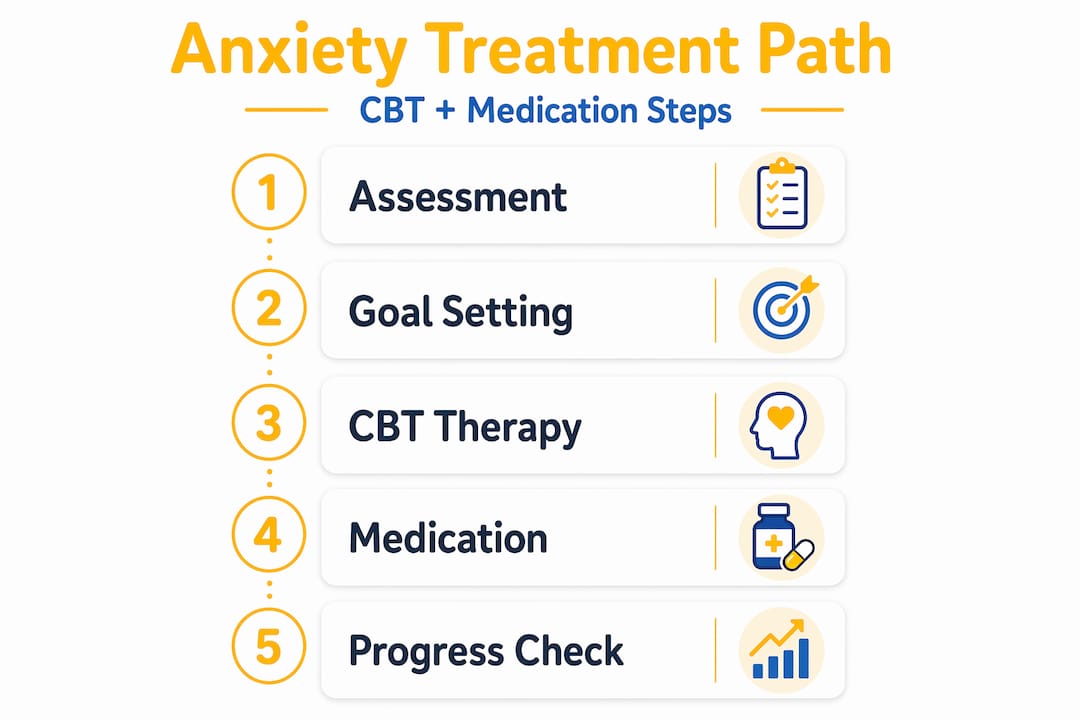
Once the type and severity of the anxiety disorder are established, the psychiatrist sets treatment goals with the patient. Those goals vary depending on:
Whether comorbid conditions like depression or substance use are present
The patient’s prior treatment history and response
Functional impairment at work, school, or in relationships
Patient preferences and motivation for different treatment modalities
This collaborative goal-setting is what separates psychiatric care from a quick prescription refill. It creates a shared roadmap.
Psychotherapy options for anxiety disorders
Therapy is not a supplement to psychiatric treatment. For many people, it is the most powerful intervention available.
CBT shows large effect sizes in reducing anxiety across multiple disorder types, making it the most evidence-backed therapy option in psychiatry. The core mechanism is straightforward: CBT helps patients identify distorted thought patterns, challenge them, and gradually change the behaviors that keep anxiety alive. A typical course runs 12 to 20 sessions with a trained therapist, and results are measurable by the end of treatment.
What happens in CBT sessions
Sessions are structured, not open-ended. Early sessions focus on psychoeducation, teaching you how anxiety works and what maintains it. Middle sessions introduce cognitive restructuring, where you learn to examine and dispute catastrophic thinking. Later sessions center on graded exposure, meaning controlled, graduated contact with the things you fear most. This is where the real change happens.

For OCD and related conditions, Exposure and Response Prevention (ERP) is the specific CBT variant with the strongest evidence. It works by exposing patients to anxiety-triggering situations while preventing the compulsive behaviors that normally follow. The brain learns through repeated experience that the feared outcome does not materialize. Over time, the anxiety response weakens.
Other therapy options include psychodynamic therapy, which explores how past experiences and unconscious patterns drive current anxiety, and interpersonal therapy, which addresses how relationship patterns contribute to symptoms. These are used when CBT is not the right fit or when relational dynamics are a primary driver.
Pro Tip: When searching for a therapist, ask directly about their training in anxiety-specific CBT and how many anxiety disorder cases they have treated. General therapy training does not automatically produce expertise in structured exposure work. Specialized training and documented experience in anxiety-focused CBT produce significantly better outcomes.
Medication management for anxiety disorders
Medication does not eliminate anxiety. What it does is lower the neurobiological threshold that makes anxiety feel unmanageable, creating conditions where therapy can actually take hold. That distinction changes how you should think about every prescription your psychiatrist writes.
First-line medications: SSRIs and SNRIs
Selective serotonin reuptake inhibitors (SSRIs) are the first choice for most anxiety disorders. Medications like sertraline and escitalopram have strong evidence across GAD, social anxiety, panic disorder, and OCD. The honest number is this: 30 to 50% of patients respond adequately to the first SSRI offered. That means some people need a second or third option before finding the right fit.
Serotonin-norepinephrine reuptake inhibitors (SNRIs) such as venlafaxine and duloxetine are a close alternative, particularly useful when anxiety presents alongside significant fatigue or pain. The choice between an SSRI and an SNRI often comes down to side effect profiles and the patient’s specific symptom cluster.
Key facts about psychiatric medication management for anxiety:
SSRIs are started at subtherapeutic doses to reduce initial agitation and side effects. Gradual dose titration is standard practice, not optional.
Most patients need 4 to 6 weeks to notice meaningful improvement. Full therapeutic effect can take up to 12 weeks.
Stopping an SSRI abruptly causes discontinuation syndrome. Any taper must be done gradually and with guidance.
Side effects, including initial nausea, sleep changes, or sexual side effects, are common in the first two weeks and often resolve without stopping the medication.
Long-term treatment plans vary. Some patients take medication for 12 months. Others take it indefinitely, especially with recurring severe anxiety.
Benzodiazepines: limited role, serious risks
Benzodiazepines like lorazepam and clonazepam work fast. That speed is exactly why they are not recommended as first-line treatment. They carry real risks of physical dependence, cognitive impairment, and rebound anxiety. Responsible psychiatric practice limits their use to short-term, tightly monitored situations, such as bridging the gap while an SSRI becomes effective, or managing acute panic before a high-stakes event.
Coping strategies psychiatry recommends
Psychiatric treatment never operates in a vacuum. What you do between appointments shapes how well treatment works.
Sleep is not negotiable. Anxiety and sleep disruption feed each other in a well-documented cycle. Psychiatrists routinely address sleep hygiene directly, including consistent sleep and wake times, limiting screens before bed, and avoiding alcohol as a sleep aid.
Physical activity improves anxiety symptoms measurably. A single session of moderate exercise can produce noticeable symptom relief within 30 minutes. Regular aerobic exercise over weeks produces changes in how the autonomic nervous system responds to stress, effects that overlap meaningfully with what medication achieves.
Other practices your psychiatrist may recommend include:
Limiting caffeine, which directly amplifies physiological arousal
Mindfulness and slow breathing techniques to interrupt acute anxiety spirals
Grounding exercises (the 5-4-3-2-1 sensory technique) for moments of high distress
Structured self-help resources and digital tools as between-session support
Pro Tip: Lifestyle changes work best when they are treated as part of treatment, not as an alternative to it. Patients who combine physical activity, sleep hygiene, and formal therapy consistently outperform those who use any single approach in isolation.
Why psychiatry favors integrated treatment plans
The evidence for combining therapy and medication is not subtle. Combination treatment with both an SSRI and CBT produces higher response rates and better functional outcomes than either approach alone for moderate to severe anxiety disorders.
Treatment approach | Best suited for | Key advantage |
CBT alone | Mild to moderate anxiety | Durable skills; no medication side effects |
Medication alone | Patients unable to access therapy | Rapid symptom reduction |
Combined CBT and medication | Moderate to severe anxiety | Highest response and remission rates |
Collaborative Care Management | Complex or chronic cases | Coordinated support across multiple providers |
The Collaborative Care Management model brings psychiatrists, primary care clinicians, and care managers together around a single patient. Research shows this approach produces better symptom control and functional improvement than standard primary care management alone. It is particularly valuable for patients with anxiety layered on top of chronic physical health conditions.
Progress is tracked using the same standardized scales used at intake. If a patient is not showing improvement at 6 to 8 weeks, the psychiatrist adjusts the plan. That might mean increasing a dose, switching medications, adding a different therapy modality, or referring to a specialist in a specific subtype like OCD or PTSD.
My honest take on what actually moves the needle
I have spent years looking at what separates patients who make lasting progress from those who cycle through treatments without sustained relief. And the pattern is consistent.
Medication matters, but it acts as a neurobiological scaffold. It does not do the work. It creates a biological window where the work becomes possible. Patients who take their SSRI but avoid exposure exercises, or who attend therapy passively without doing the between-session work, consistently plateau.
The therapy variable that most people overlook is intensity and frequency of exposure. Under-exposure to feared stimuli during treatment is one of the strongest predictors of poor outcomes. When exposure is too mild, too infrequent, or systematically avoided through subtle safety behaviors, the brain never completes the inhibitory learning it needs. I have seen patients in therapy for years who were never genuinely challenged by their exposure work, and they remained stuck.
The other thing I would tell anyone starting psychiatric treatment for anxiety: persistence is not passive. It means staying engaged, asking your prescriber questions, flagging what is not working, and advocating for a different approach if the current one is stalled after a reasonable time. Integrated care works. But it requires a patient who treats their own recovery as an active process, not a service being delivered to them.
— Martin
How 2ndarc can help you take the next step
If you have read this far, you are already taking your mental health seriously. That matters.

2ndarc (Second Arc Psychiatric Associates) provides personalized psychiatric care for anxiety disorders that combines evidence-based therapy guidance with precise medication management, all tailored to your specific situation. Both in-person and telehealth appointments are available across New York, with access often available within 24 hours. Most major insurance plans are accepted. Whether you are seeking your first psychiatric evaluation or looking for a more integrated treatment plan than you have had before, the team at 2ndarc works with you, not just for you. Booking a consultation is a straightforward first step toward a treatment plan built around your actual needs.
FAQ
What does a psychiatrist do differently from a therapist?
A psychiatrist is a medical doctor who can diagnose anxiety disorders, prescribe and manage medications, and coordinate care with other providers. Many also provide therapy, though in integrated care models they often collaborate with dedicated therapists.
How long does psychiatric treatment for anxiety typically take?
Most patients see meaningful improvement within 3 to 6 months of starting combined therapy and medication. CBT typically runs 12 to 20 sessions, and medication plans are reviewed regularly based on response and tolerability.
Are SSRIs safe for long-term anxiety treatment?
SSRIs are considered safe for long-term use under psychiatric supervision. Your prescriber will monitor side effects, assess the continued need for medication at regular intervals, and guide any tapering if you and your doctor decide to discontinue.
Can anxiety disorders be treated without medication?
Yes. CBT and exposure-based therapies produce strong outcomes for mild to moderate anxiety without medication. For moderate to severe cases, combination treatment with both therapy and medication produces the best overall results.
What should I bring to my first psychiatric appointment?
Bring a list of current medications and supplements, any prior mental health diagnoses or treatments, a description of your symptoms and how long they have been present, and any relevant medical records. The more complete your history, the more targeted your initial treatment plan will be.
Recommended


Comments